
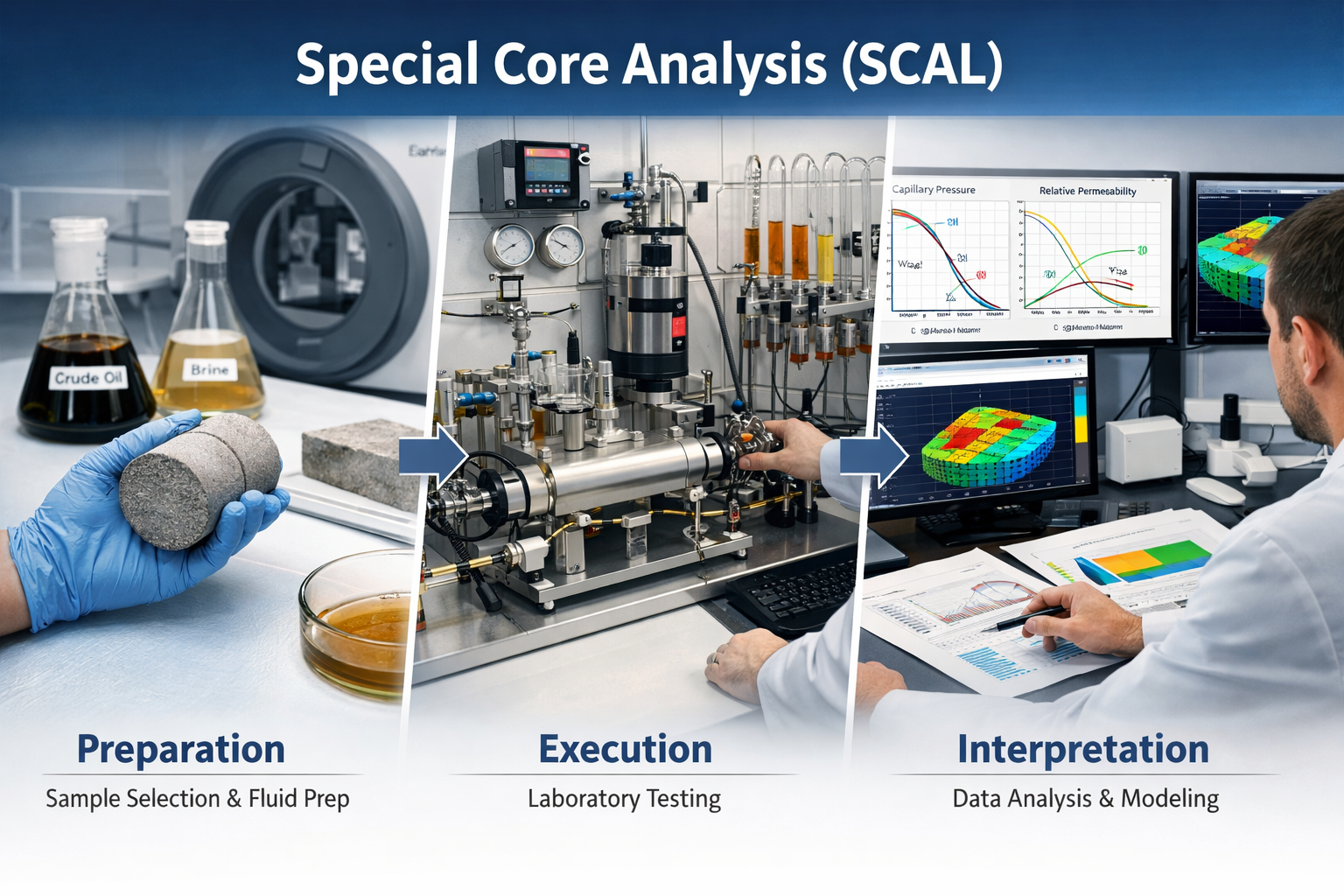
- Content and Thematic Scope This module provides a detailed review of all stages that precede SCAL testing, combining both theoretical and practical aspects. The main themes are summarized as follows: Thematic Area Topics Covered Professional Competencies Fluid Preparation and Characterization Synthesis of formation water, resistivity, viscosity, density, contamination control, handling of crude and synthetic oils, and gas characterization Ability to prepare and evaluate representative fluids for laboratory experiments Sample and Core Plug Selection Selection criteria, CT scanning, classification of plugs, detection of heterogeneities, and damage Capability to identify and select suitable samples for dynamic and static testing Reservoir Stress and Effective Stress Evaluation Calculation of effective overburden stress (uniaxial and isostatic methods), Poisson’s ratio, Biot coefficient, and stress regime interpretation Understanding of how to reproduce reservoir conditions in laboratory environments Sample Integrity and Quality Control Preservation, transport, and restoration methods for core samples Recognition of potential sources of error and quality assurance procedures SCAL Measurement Techniques Capillary pressure, wettability, relative permeability, porosity, and permeability determinations Knowledge of analytical methods and instrumentation used in SCAL testing Learning Objectives Participants will gain a solid understanding of: · The types of SCAL experiments and their objectives. · Procedures for sample selection, preparation, and preservation to maintain integrity and representativeness. · Methods for fluid characterization (formation water, crude oil, gas) and stress evaluation to replicate reservoir conditions. · Advantages, limitations, and constraints of different SCAL techniques and laboratory equipment. · The validation process for SCAL data before integration into petrophysical, geomechanical, or reservoir simulation workflows. 3. Professional Scope and Objectives This course provides conceptual and technical training , allowing participants to: · Understand the range of SCAL laboratory techniques available, the type of information each method generates, and the limitations or uncertainties associated with them. · Develop technical judgment to validate and interpret SCAL data before integration into reservoir models. · Recognize the conditions of applicability for laboratory data, such as stress, temperature, and sample representativeness. · Evaluate the reliability and quality of SCAL datasets to ensure they can be used confidently in reservoir characterization workflows. 4. Target Audience Professional Domain: This course is situated in the areas of petrophysics, reservoir engineering, and laboratory core analysis . It involves interdisciplinary knowledge of: · Geoscience (rock typing, lithofacies, CT imaging) · Reservoir physics (fluid–rock interactions, capillary pressure, wettability) · Petroleum engineering (stress modeling, PVT analysis, reservoir simulation inputs) The modules are intended for professionals working in the upstream sector of the oil and gas industry, particularly those involved in subsurface characterization and reservoir development. Professional Profile Relevance of SCAL Knowledge Petrophysicist / Core Analysts Design and interpret core analysis experiments (RCA/SCAL) Interpret rock and fluid properties, correlate core and log data, validate saturation and relative permeability curves, and integrate SCAL results into petrophysical models. Reservoir Engineers Use SCAL data to improve reservoir models and recovery predictions. Apply SCAL derived data (wettability, capillary pressure, relative permeability) to estimate saturations, fluid contacts, and provide reliable input for dynamic simulation models. Geomechanics Specialists Use data on effective stress, rock compressibility, and mechanical response under reservoir conditions. Geoscientists and Geologist Understand acquisition, pres